
GPS Anti-Spoofing in UAV Operations
The development team at Aervizio maintains constant dialogue with operators in the field, continuously refining its systems based on real-world feedback. One of the most pressing challenges in modern UAV operations—particularly in contested environments—is the impact of electronic warfare (EW). Adversarial systems are capable not only of jamming satellite signals but also of manipulating them through spoofing.
When GPS signals are lost entirely, UAVs can fall back on inertial navigation systems, visual navigation, or manual visual piloting. However, spoofing presents a far more insidious threat. Unlike signal loss, spoofed GPS data appears valid to the flight controller, which prioritizes GPS as the most accurate positioning source under normal conditions.
In practice, this means that when falsified coordinates are injected, the flight controller accepts them without hesitation—even if the resulting calculations imply physically impossible movement, such as speeds exceeding the speed of sound. The system simply lacks the contextual awareness to question the integrity of the data.
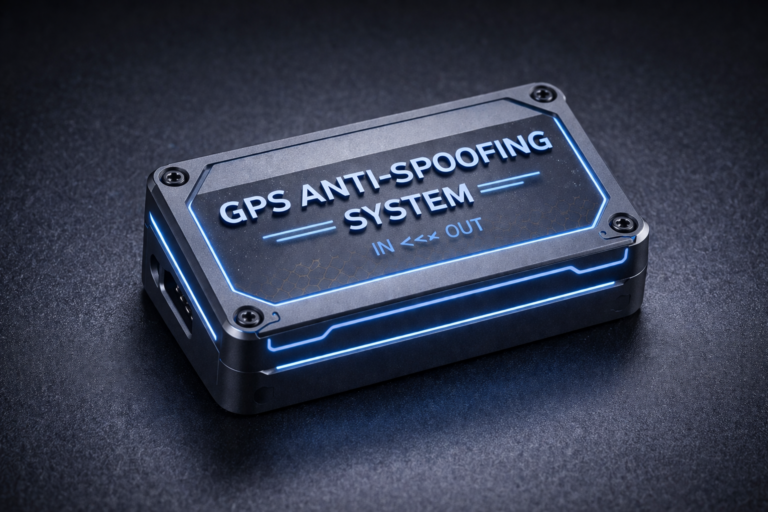
To address this critical vulnerability, our engineers developed a dedicated solution: the GPS Anti-spoofing system.
Existing Approaches to Countering GPS Spoofing
Several strategies are currently employed to mitigate spoofing risks, each with notable trade-offs:
1. GPS Deactivation in High-Risk Zones
The most common approach involves disabling the GPS module during takeoff or when entering areas suspected of EW activity. In this mode, the UAV relies entirely on its inertial navigation system.
However, inertial systems accumulate error over time. Environmental factors such as wind and weather changes further degrade accuracy. On long routes, positional error can reach 5–10% of the total distance. For example, on a 50 km mission, deviation may exceed 5 km—often unacceptable for precision operations.
2. Manual Correction via Secure Communication
A more advanced method uses secure communication links and onboard video feeds, allowing operators to manually correct positioning in real time. If spoofing is detected, the operator can assign updated coordinates based on visual landmarks.
While effective, this method introduces significant operational constraints:
Continuous operator involvement is required
Persistent communication link must be maintained
Reliable video transmission is essential
In essence, the UAV ceases to be fully autonomous.
3. Military-Grade GPS and CRPA Antennas
High-end solutions include protected military GPS receivers and CRPA (Controlled Reception Pattern Antenna) systems. These technologies can suppress interference from specific directions, effectively neutralizing spoofing signals.
However, such systems come with substantial drawbacks:
Starting cost typically exceeds $10,000
Subject to export restrictions due to dual-use classification
Economically impractical for UAV platforms below similar cost thresholds
Concept of the GPS Anti-spoofing System
The engineering objective was clear: develop a solution that balances cost, accuracy, and autonomy. The system needed to:
Remain economically viable
Deliver higher positioning accuracy than inertial navigation alone
Operate fully autonomously, without requiring in-flight operator intervention
The result is a uniquely engineered GPS Anti-spoofing system, designed and built with the involvement of highly skilled mathematicians and software engineers.
How the GPS Anti-spoofing System Works
The system is a standalone hardware unit with an embedded software layer. It is physically installed between the GPS receiver(s) and the flight controller.
Architecture:
Supports 1 to 3 GPS receivers simultaneously
Receives raw GPS data before it reaches the flight controller
Outputs validated data via a dedicated interface
Core Functionality:
The system continuously evaluates incoming GPS data and makes a binary decision:
Pass through valid coordinates
Block suspected spoofed data
The underlying algorithm—proprietary and rigorously tested—analyzes signal behavior patterns to detect anomalies indicative of spoofing.
Integration:
Compatible with a wide range of flight controllers
Requires no firmware modification of the flight controller
Only minor configuration adjustments are needed
GPS modules must support the NMEA protocol and be validated within the system firmware
Operational Validation
The GPS Anti-spoofing system has undergone extensive field testing, including controlled trials and over a year of deployment in real operational conditions. Its reliability has been proven in both reconnaissance and strike UAV systems, where it is now standard equipment
Key Advantages
1. Dramatically Reduced UAV Loss Risk
By preventing corrupted navigation data from reaching the flight controller, the system significantly lowers the probability of mission failure or platform loss.
2. Cost Efficiency
The system provides a practical alternative to expensive military-grade solutions, making advanced protection accessible for a broader range of UAV platforms.
3. Improved Positioning Accuracy Under EW Conditions
In the absence of spoofing: accuracy matches standard GPS performance
During spoofing: invalid data is blocked, and the UAV relies on inertial navigation
When valid GPS signals reappear:
The system resumes data transmission
Accumulated inertial drift is corrected
Overall navigation accuracy is restored
Even brief access to clean GPS data is sufficient to recalibrate the system and significantly improve mission precision.
4. Full Autonomy
The entire process is automatic. The UAV requires no operator intervention to detect or respond to spoofing. Once interference ceases, GPS data flow resumes seamlessly.
5. Multi-Receiver Capability
By supporting up to three simultaneous GPS receivers, the system increases the likelihood of acquiring valid positioning data—even in challenging environments.
Conclusion
Reliable navigation is critical for any UAV mission, especially in environments where electronic warfare is present. The GPS Anti-spoofing system provides a practical and effective way to protect UAVs from spoofed GPS data while maintaining high accuracy and full autonomy.
By combining intelligent signal validation with seamless integration into existing systems, it allows UAVs to continue operating even under challenging conditions—without the need for constant operator intervention or expensive military-grade hardware.
If you would like to learn more or discuss how this solution can be integrated into your platform, contact us for a detailed consultation.